 Excursionfrom€150
Erg Chigaga overnight, 2 days
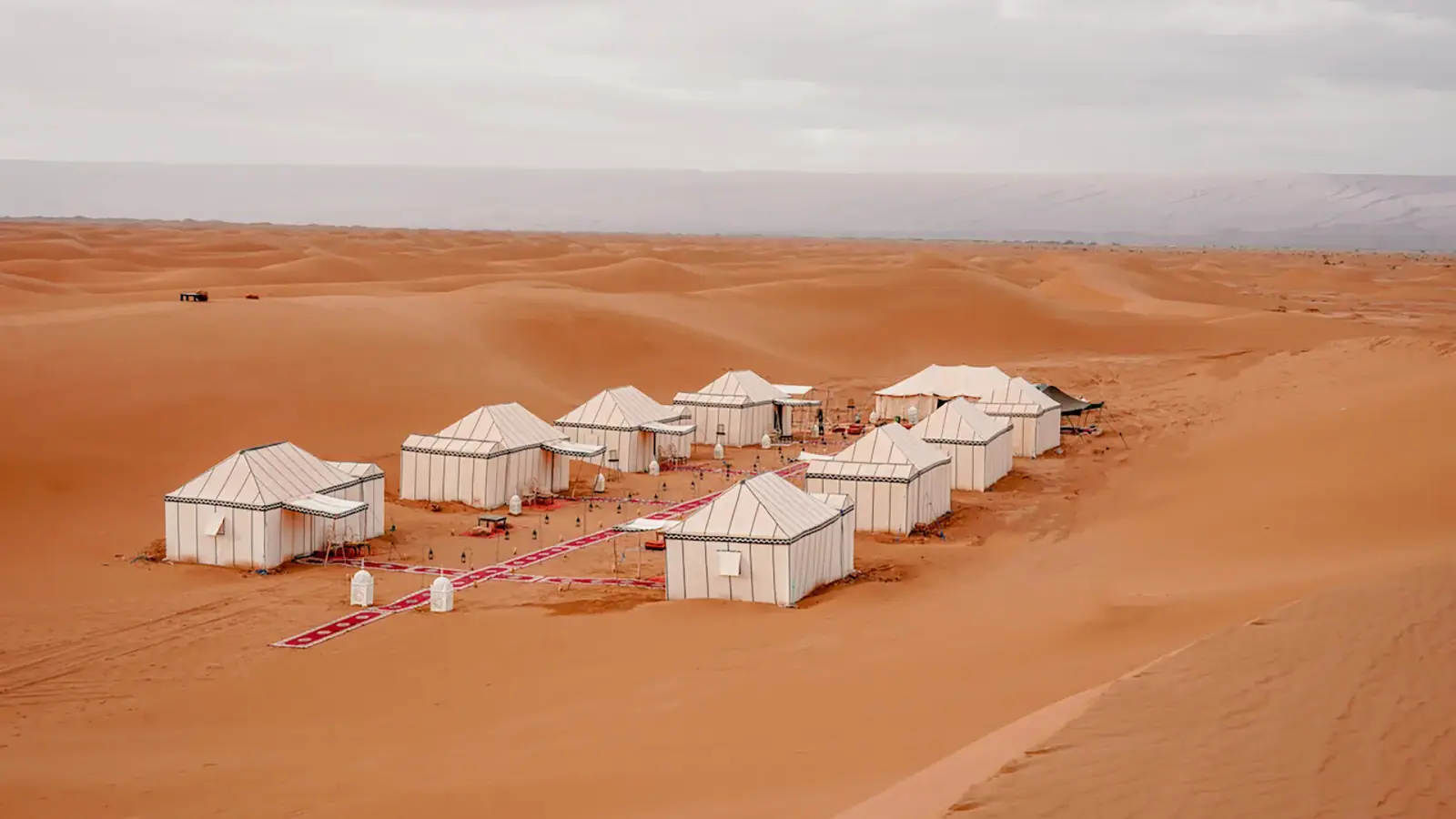
The flat Iriki basin, dusk from a camel’s back, a fireside supper, then nomad-style beds among the dunes.
Camel ride included
Bivouac · Chegaga dunes
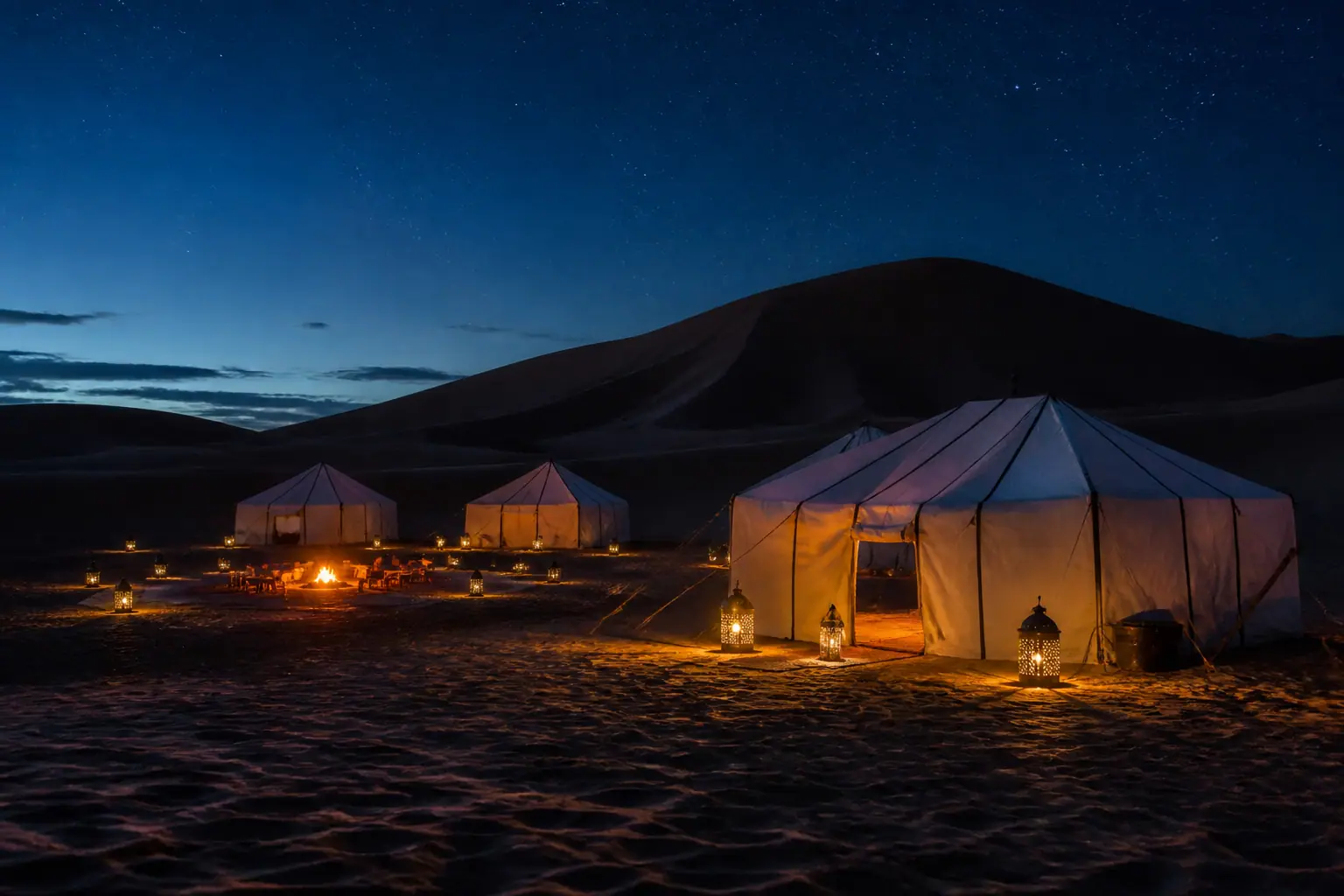
An Erg Chigaga camp is where the big dunes make sense: the sun dropping behind the crests, dinner by the fire, a crowded sky and cold sand at dawn. Here is how a night in Erg Chigaga works.
In short
A night at an Erg Chigaga camp is part of ten private trips, from two days out of Foum Zguid (from €150) to four-day loops and treks. You reach the dunes by 4×4 in the afternoon, watch the sunset from a crest – often after a camel ride – eat dinner by the fire and spend the night under canvas, then get up for sunrise and breakfast before the drive out.
Visit Erg Chigaga for an afternoon and you see the dunes at their flattest, under a high sun, then you leave before the light turns. Stay at an Erg Chigaga camp and you get the hours that people actually remember: the slow reddening of the ridges, the moment the wind drops after sunset, the stars, and a cold, clean sunrise with nobody else’s footprints on the slope.
It also makes sense of the journey. Reaching the erg means a 2½–3 hour piste from Foum Zguid, or a long road day from Marrakech or Agadir. Turning round after an hour in the sand is a lot of driving for very little. This page covers the night itself. For the dunes in general, see our Erg Chigaga guide, and for the tracks that lead there, how to get to Erg Chigaga.
Each programme has its own details, but read together they describe an evening that runs roughly like this:
On the trips from Zagora, the camel ride comes earlier, at M’Hamid, before the drive to camp. On the three-day loop there is time after sunrise to walk in the dunes before leaving.
We describe only what the programmes themselves state, and suggest you ask about the rest:
Abdul answers these for your dates; camps differ, and we would rather tell you exactly than promise something in general terms.
| Trip | Starts in | Nights at Chigaga | Camel | From |
|---|---|---|---|---|
| Two days to the Chigaga camp | Foum Zguid | 1 | Included | €150 |
| Zagora and back by Lake Iriki | Zagora | 1 | Included, one hour at M’Hamid | €235 |
| Fossils, Titanic Iriki and Chigaga | Foum Zguid | 1 (plus one at Titanic Iriki) | Included | €270 |
| Ouarzazate loop | Ouarzazate | 1 | Not in the programme – ask | €300 |
| Grand desert tour | Foum Zguid | 2 (plus one at El Mhazil) | Included | €390 |
| Agadir circuit | Agadir | 1 | Included | €420 |
| Marrakech in three days | Marrakech | 1 | Included, at sunset | €450 |
| Marrakech in four days | Marrakech | 2 | Included | €570 |
| Oasis trek to Chigaga | Agadir or Marrakech | 1, then camps further on | Caravan carries the luggage | €650 |
| Seven-day trek from Agadir | Agadir | 1, after the great dune | Caravan carries the luggage | €750 |
Per-person prices, based on two travellers; some trips are cheaper per head for four or more. In July and August the circuits from Marrakech and Agadir may swap the dune night for an oasis night when it is too hot; you will know before you book. The Erg Chigaga day trip (from €110) stops at a camp for tea but does not stay the night.
One night gives you the essential pair: an evening and a morning. It suits travellers with limited time, and from Foum Zguid it fits into two days without rushing. From Zagora or Ouarzazate, it is the whole point of the two-day loops.
Two nights change the experience more than you might expect. The middle day has no drive at all: you can be on a crest at sunrise, try sandboarding on a steep face, sleep through the heat in the tent and share tea with nomads if a family happens to be camped close by. Two trips offer this:
If you can spare the extra day, take it – that is our honest advice. If you cannot, one night still gives you the best of the dunes.
| Period | Evenings and nights at camp | What it means for you |
|---|---|---|
| October–November | Mild days, cooler nights | A light fleece; ideal for sleeping out under the sky |
| December–February | Nights can come close to freezing | Warm layers, hat and possibly your own sleeping bag; the Tichka pass from Marrakech can have snow |
| March–April | Pleasant, but wind can raise the sand | A scarf for your face and a closed bag for your camera |
| May–June | Hot days, warm nights | Plenty of water; the grand tour’s season ends in early June |
| July–August | Daytime heat regularly over 40 °C | The Marrakech and Agadir circuits may sleep at an oasis instead; keep outings short and start early |
The most comfortable months overall are October to April. The best time to visit guide has the weather in more detail.
On the treks, the kit list is longer – sleeping bag, walking shoes, a daypack – and each trek page gives its own.
Night is often the highlight of a stay at a desert camp at Erg Chigaga. There are no towns for many kilometres in any direction, so on a clear night without moon the Milky Way stretches from horizon to horizon. A few tips for making the most of it:
The erg looks endless, but it is a fragile place with people living around it. A few habits keep it that way:
Chigaga is not the only place to spend a night in this desert. Smaller camps at Erg Lmhazil and the earth-built rooms of Titanic Iriki are compared in our guide to sleeping in the Morocco desert. All trips that start in town are listed among the Foum Zguid desert tours, and the Foum Zguid town guide helps with arriving the evening before. To ask about a night in the dunes on your dates, use the booking page.
Excursionfrom€150The flat Iriki basin, dusk from a camel’s back, a fireside supper, then nomad-style beds among the dunes.
Camel ride included
 Tourfrom€270
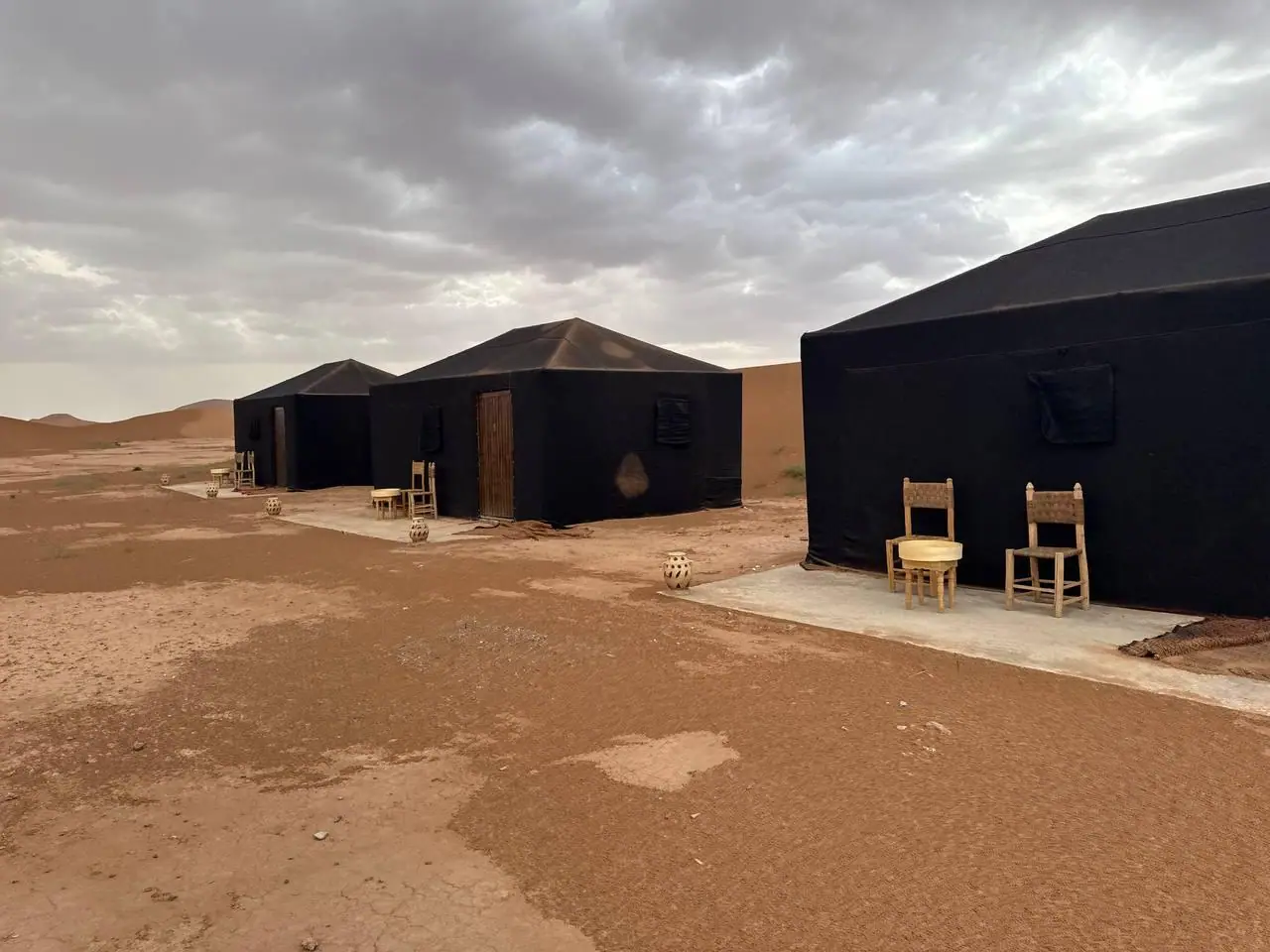
Fossil ground, a sunset at Titanic Iriki, a nomad school, then camels and music among the dunes.
Camel ride included
Tourfrom€570A guesthouse in Foum Zguid, two camp nights and a full free day for sandboarding and sunrise walks.
Camel ride included
 Tourfrom€390
A day off in the Chigaga sand, the near-empty El Mhazil dunes and engraved rocks below the Jebel Bani.
Camel ride included
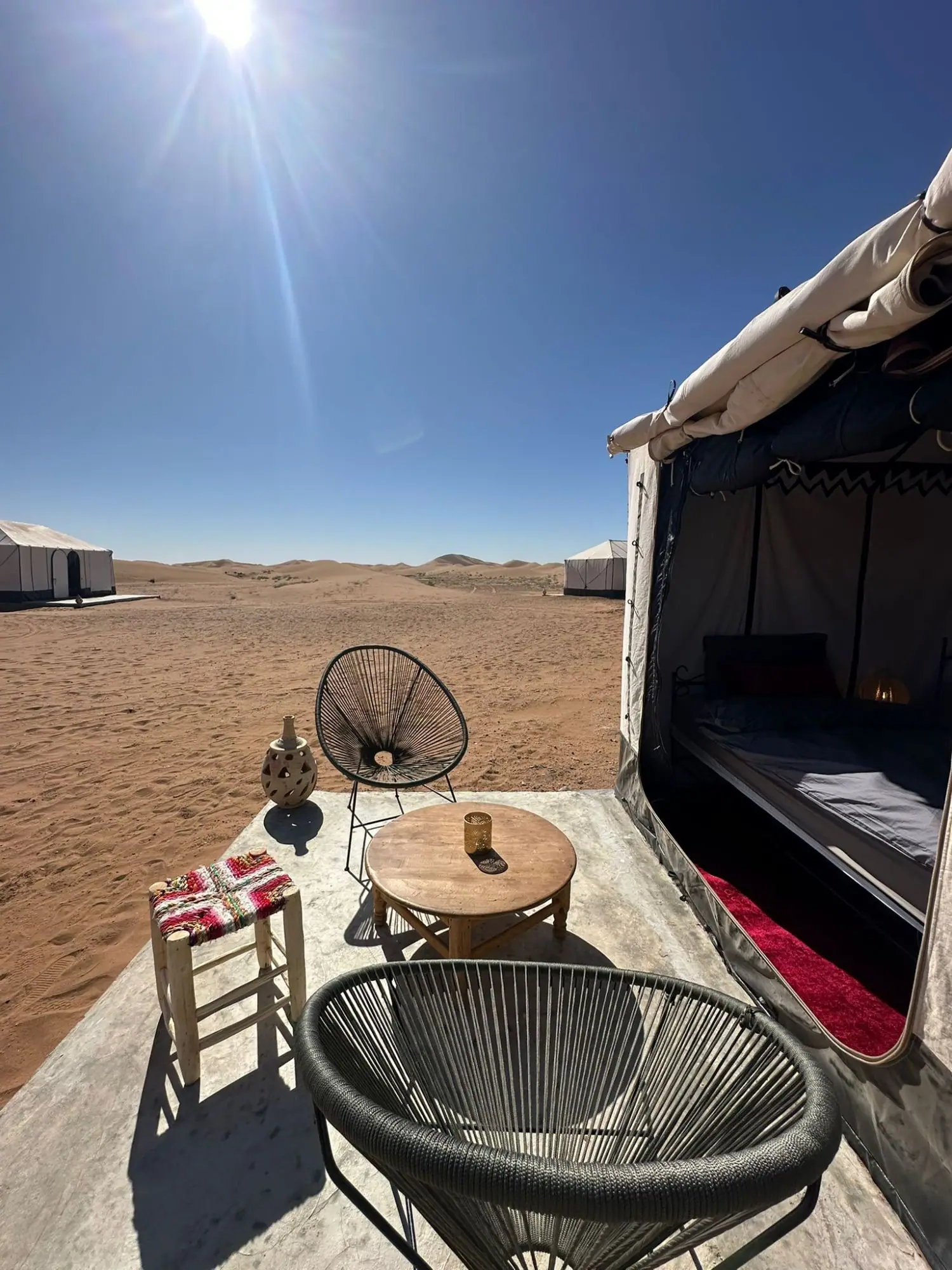
It is a group of tents set among the dunes, far from any road, where you arrive by 4×4 in the afternoon. The programmes describe a nomad tent or an equipped desert camp, dinner by the fire, tea, sometimes music, then sunrise and breakfast. Ask Abdul for the exact facilities on your dates, as they vary from one camp to another.
From December to February, nights at camp can drop close to freezing even after a sunny day, so bring a warm jacket, a hat and perhaps your own sleeping bag. In October, November, March and April the nights are cool rather than cold. In summer the nights are warm, but the days often pass 40 °C.
The published programmes do not detail washing or toilet facilities, so we prefer not to promise anything in general. Arrangements differ between camps and sometimes between seasons. Ask when you book and Abdul will tell you exactly what to expect for your trip and dates, so you can pack accordingly – wet wipes and a head torch are useful in any case.
On most of the overnight trips, yes: a ride is part of the package on the Foum Zguid overnight, the Titanic-and-Chigaga loop, the four-day grand tour and all three city circuits from Agadir and Marrakech, and the Zagora trip has an hour on a camel at M’Hamid. For the Ouarzazate loop the programme does not mention it, so ask. Treks use camels to carry the luggage.
Often, if the weather is calm and dry, but it is something to ask your guide on the evening rather than a guarantee. In autumn and spring it is a lovely way to spend the night; in winter it is very cold. Take your mattress and blankets out only with the camp team’s agreement, and keep a torch and warm clothes to hand.
The two-day trip from Foum Zguid, from €150 per person for two travellers, is the least expensive way to spend a night at the Chigaga camp. It includes the 4×4 there and back, a camel ride, dinner, the night in a nomad tent and breakfast. From Zagora, the two-day loop costs from €235 and from Ouarzazate from €300.
Yes. The four-day grand tour from Foum Zguid (from €390) and the four-day circuit from Marrakech (from €570) both spend two nights at Erg Chigaga with a free day in between, including sandboarding. If you want a different combination of nights, ask Abdul: departures are private, and the programme is confirmed with you before booking.
Do not count on either. Mobile coverage fades soon after you leave Foum Zguid, and camps in the dunes are far from any grid. Charge everything before you set off and bring a power bank. Let family know you may be unreachable for the night. If staying connected matters, ask about it when you book.
Overnight trips usually reach the dunes in the afternoon, in time for the late light and sunset. The next morning you watch the sunrise, have breakfast at camp and set off again. Timings differ by trip: the Zagora loop, for example, is back in Zagora around 13:00 on day two. Your timetable is confirmed on WhatsApp.
Booking
Send your dates, the number of travellers and the trip you like. Abdul replies with the programme and the price; nothing is booked until you agree.
WhatsApp+212 649 598 615