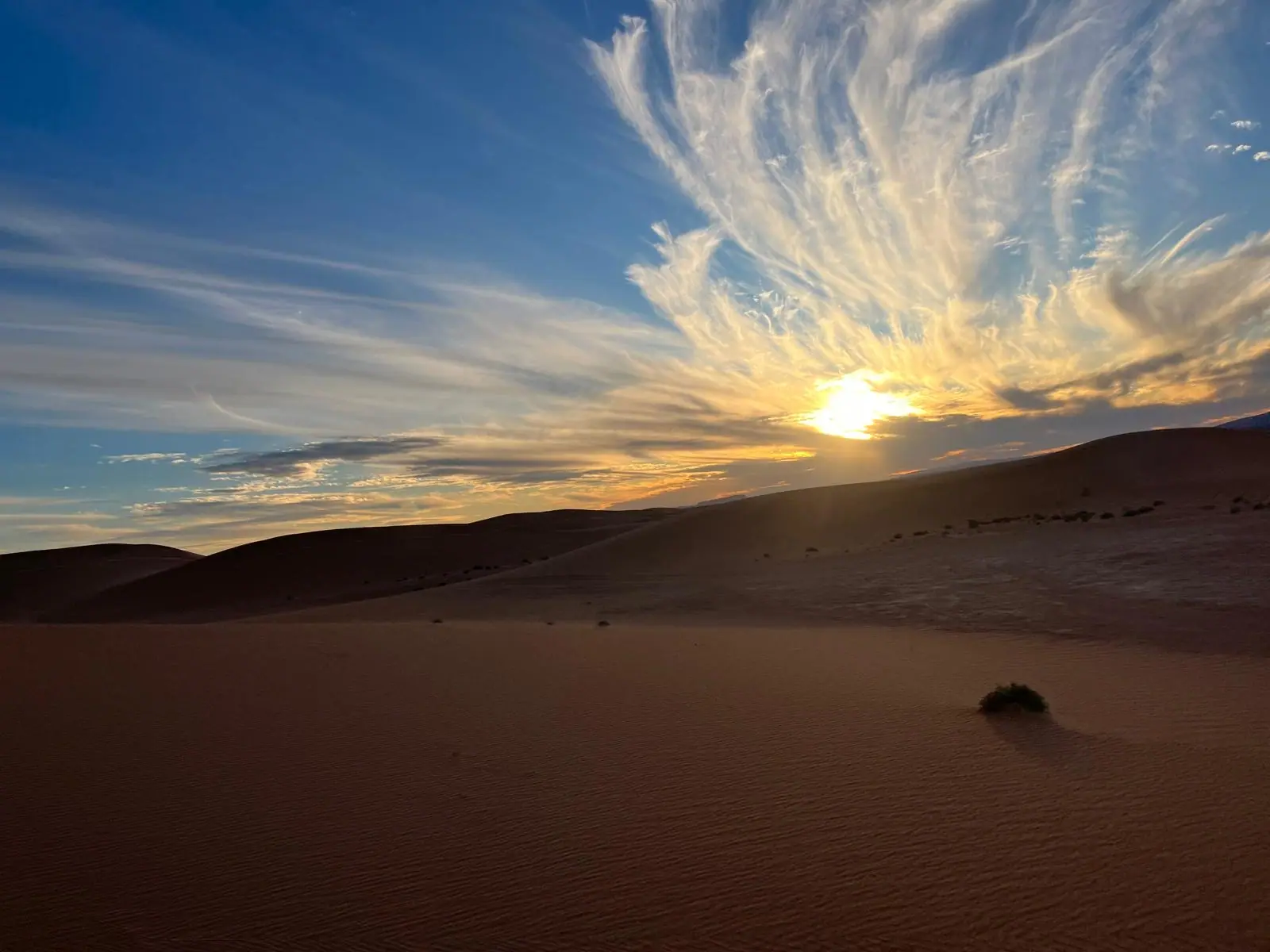
 Excursionfrom€110
Erg Chigaga in one day
Iriki park, a village lunch, a dune climb at Chigaga and the salt-white lake bed on the drive home.
Camel ride optional
Province of Tata · Jebel Bani
Foum Zguid is a palm-grove town in southern Morocco, where the Zguid river breaks through the Jebel Bani. Where it lies, how to get to Foum Zguid by road and how to spend a morning there.
In short
Foum Zguid is a town in the Province of Tata, Souss-Massa region, at about 760 m on the N12 between Tata and Zagora. Ouarzazate is roughly 150 km north via Tazenakht, Zagora about 120 km east and Agadir around 390 km (some six hours) west. Come for the Thursday souk, the palm grove and the Allogoum ksar 25 km north, then for the desert tracks that begin just south of town.
The map
Foum Zguid is the western gateway to the desert. You reach it by road from Marrakech, Agadir, Ouarzazate or Zagora; from there the track crosses the Iriki plain to the dunes.
Find the Jebel Bani on a map of southern Morocco – the long, dark ridge that crosses the Province of Tata from end to end – and follow it east until a river valley cuts a notch through the rock. That notch is Foum Zguid. The Arabic name means, quite literally, the mouth of the Zguid river, and the place still behaves like a doorway: hills and the road north behind it, open plain in front.
On paper, the town belongs to Tata Province in the Souss-Massa region, whose capital is Agadir. The 2004 census recorded 9,630 residents, which made it the second town of the province after Tata. It stands at roughly 760 m above sea level on the N12, the national road joining Tata in the south-west with Zagora in the east. Southwards there is no road of any kind: Iriki National Park opens up beyond the gardens, and further off lies the Algerian border, which no road reaches from here.
So Foum Zguid, Morocco is two things at once. It is an ordinary working town with a market, schools and walled gardens, and it is the western threshold of a desert that people cross only by 4×4 track or on foot.
The town sits at about 30°05′ N, 6°52′ W. The easiest way to picture it is by the roads that leave it – and by the one direction where none does:
Erg Chigaga itself lies outside the province, in the Drâa-Tafilalet region, and the Jebel Bani marks its northern edge – so the ridge behind Foum Zguid stays in view to the north on the way. The full track story, gateway by gateway, is in our guide on how to get to Erg Chigaga from Foum Zguid or M’Hamid.
No railway comes this far south, and the closest airport on this side of the mountains is at Ouarzazate. Most travellers arrive by car, with a hired driver, or as part of a circuit that collects them in a city. Figures below are approximate and only those we could check; where we have none, we say so.
| Coming from | Usual route | Distance and time (approx.) |
|---|---|---|
| Ouarzazate | South via Tazenakht | About 150 km |
| Zagora | West along the N12 | About 120 km |
| Agadir | Inland towards Akka Ighane, then left on the N12 through Tissint; the circuits go via Taroudant, Taliouine and Tazenakht instead | About 390 km, some 6 hours (regional tourism board) |
| Marrakech | Over the High Atlas by the Tizi n’Tichka, then down through Tazenakht | No reliable figure; the circuits leave around 8:00 and arrive late in the afternoon, with stops |
| Tata | North-east along the N12, past Tissint | Roughly 140 km (route planners; check locally) |
If you are wondering how to get to Foum Zguid by bus or shared taxi, ask locally or at your accommodation: services between the small southern towns change, and we have no timetable we would trust enough to print. If you would rather not drive at all, the circuits from the cities fold the journey into the trip: three days from Marrakech with a night in Foum Zguid (from €450), three days from Agadir by way of Taroudant and Taliouine (from €420), or the two-day loop from Ouarzazate (from €300), which comes home through Foum Zguid and the Zguid valley. Our city pages give the whole road: from Marrakech, from Agadir and from Ouarzazate and Zagora.
Nobody would call it a museum town, and that is part of its charm. The things to do in Foum Zguid are mostly what residents do anyway, plus a handful of sites in the surrounding hills:
Many desert departures from town leave around midday or early in the afternoon, which leaves the morning free. A loose plan that works:
Only passing through on the N12? An hour among the palms and a glass of tea will do.
Accommodation here is small-scale: guesthouses and auberges rather than big hotels. We do not list names, because the right choice depends on your budget, dates and plans; Abdul knows the places in town and will suggest one when you write.
Several programmes build a night in town into the trip:
Driving yourself? Arriving the evening before a desert trip is the sensible way round: you set off rested, the pick-up is arranged in town, and your hire car stays parked while you are away.
The comfortable months run from about October to April, with warm, bright days and cool evenings. From December to February nights in the desert can fall close to freezing, so pack a warm layer even if lunch was eaten in the sun. Summer is another matter: days often climb above 40 °C, only the early and late hours are pleasant outdoors, and in July and August some circuits from the cities replace the dune night with one at an oasis. Spring can bring strong wind and sand in the air. For month-by-month conditions, see the best time to visit the Morocco desert.
One more tip: if you want to see the souk, plan your stay around a Thursday.
Most visitors find Foum Zguid on a map because of what lies to the south. In brief:
Every trip that leaves from town – day excursions, one-night camps, longer loops and treks with camels carrying the bags – is compared on the Foum Zguid desert tours page. Once you know what you want, send your dates to Abdul through the booking page.
Excursionfrom€110Iriki park, a village lunch, a dune climb at Chigaga and the salt-white lake bed on the drive home.
Camel ride optional
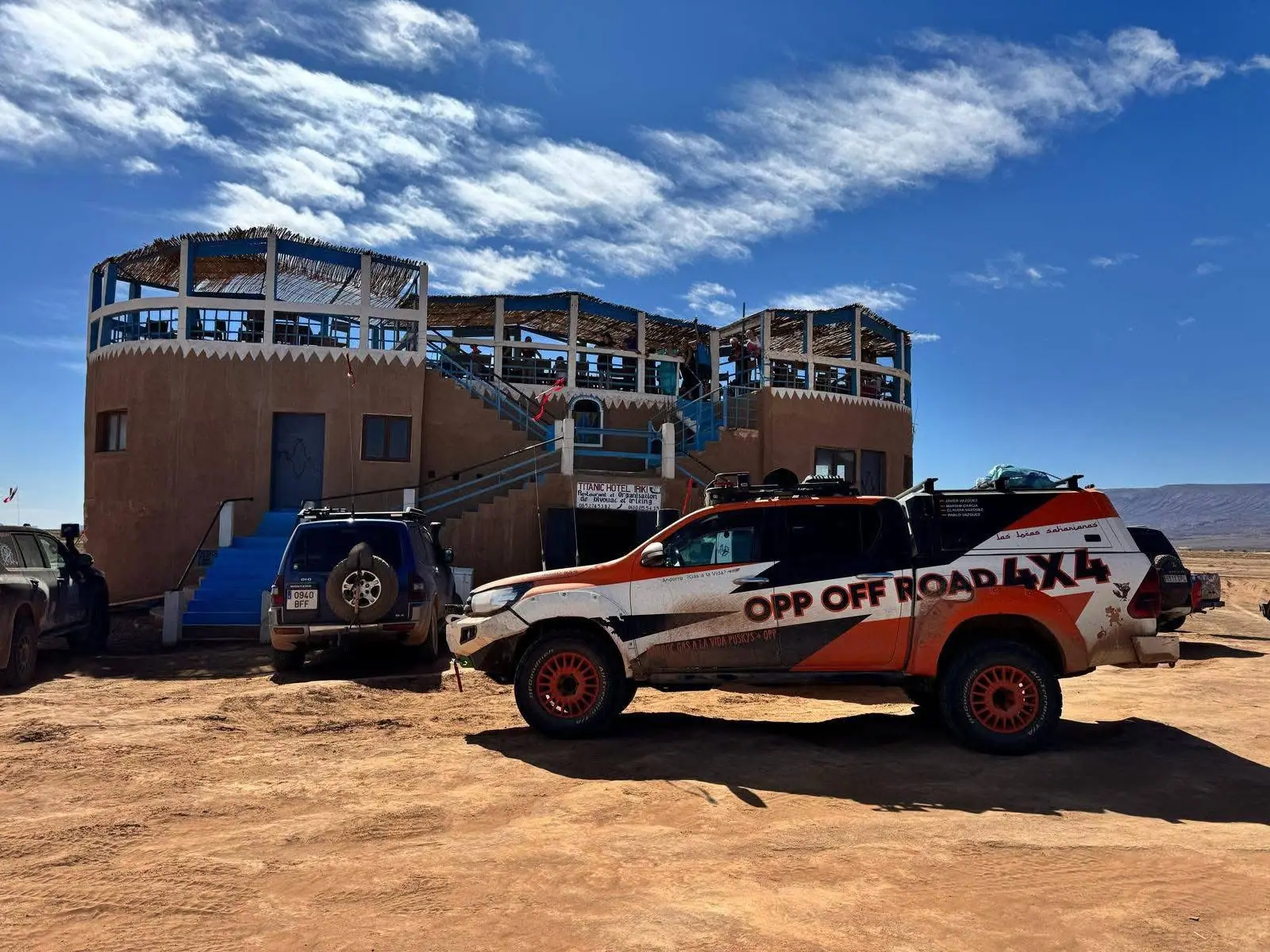 Excursionfrom€90
Cracked salt, odd rock shapes and wide horizons, then a slow meal at the ship-styled Titanic Iriki.
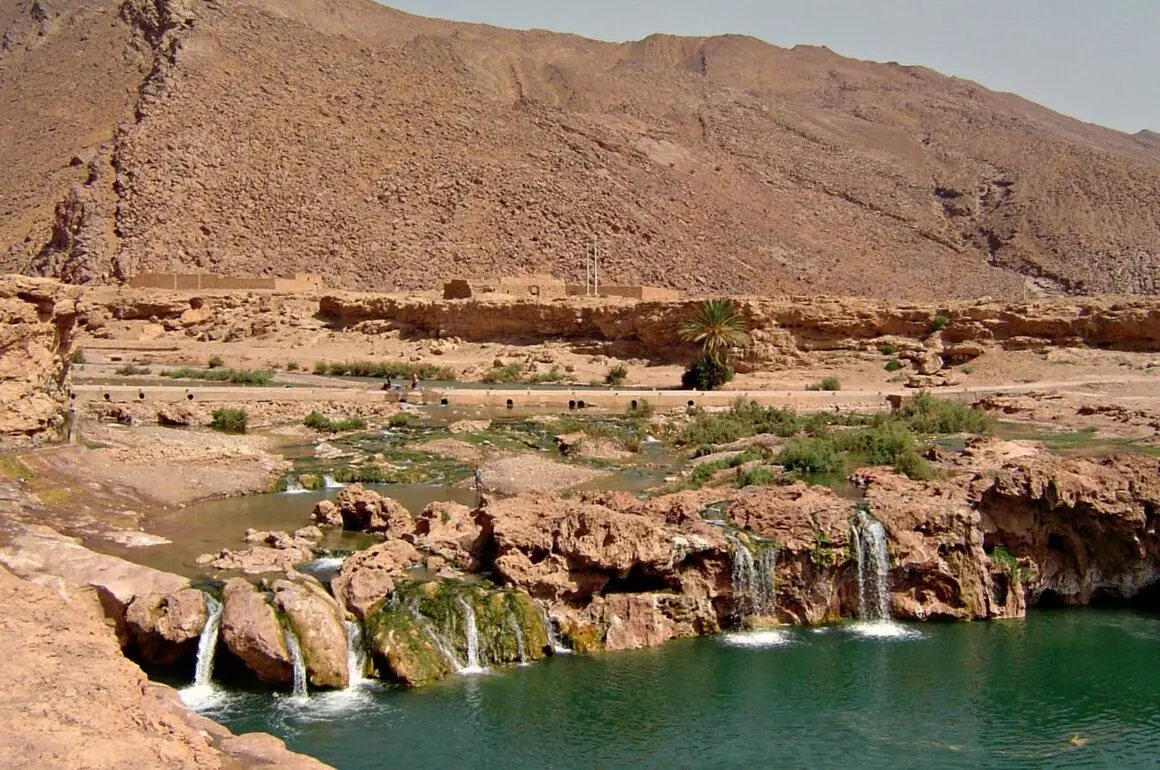 Excursionfrom€100
A salty river falling into pools, a narrow canyon and tafernoute bread warm for lunch.
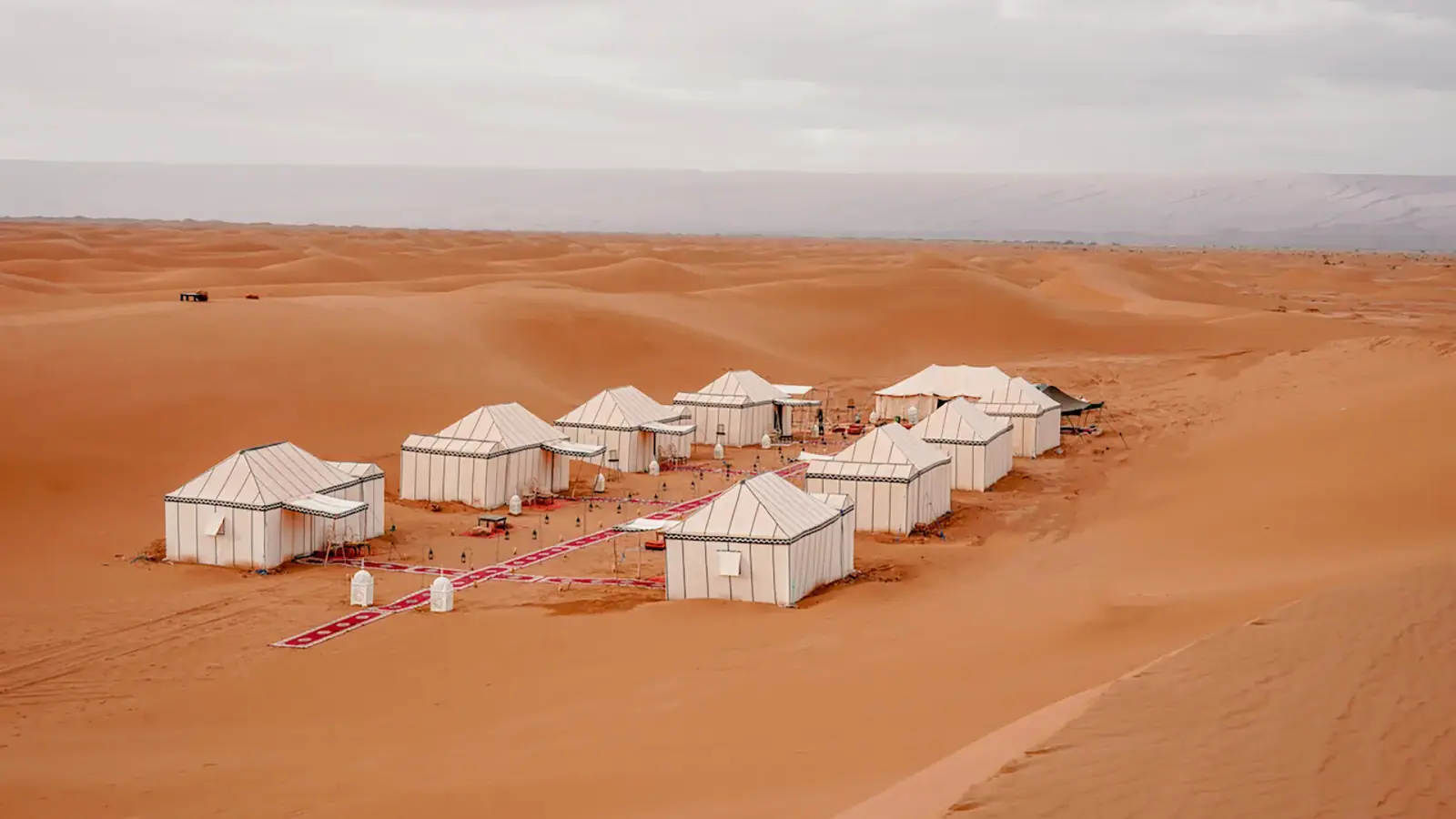 Excursionfrom€150
The flat Iriki basin, dusk from a camel’s back, a fireside supper, then nomad-style beds among the dunes.
Camel ride included
Foum Zguid is in southern Morocco, in the Province of Tata and the Souss-Massa region. It lies at about 760 m on the N12, the road between Tata and Zagora, where the Zguid river passes through the Jebel Bani ridge. Ouarzazate is roughly 150 km to the north via Tazenakht, and Iriki National Park begins just south of the town.
By road over the High Atlas on the Tizi n’Tichka pass, then south through Tazenakht. We have no reliable distance or driving time to quote, but it is a full day: the circuits leave Marrakech around 8:00, stop at Aït Ben Haddou and for lunch in Tazenakht, and reach Foum Zguid in the late afternoon. There is no train, and for buses it is best to ask locally.
Visit the Thursday souk, walk through the palm grove, look at the remains of the old kasbah and browse the craft centre opened in 2022, or the carpet and basketry cooperatives. Drive 25 km north to the ksar of Allogoum, under restoration, or see rock engravings in the Jebel Bani with a local guide. Then head south into the desert.
The town has guesthouses and auberges rather than large hotels. We do not publish names because the best choice depends on your dates and budget, but Abdul can recommend somewhere when you get in touch. Several trips include a night in town: the city circuits use a guesthouse, and the six-day oasis trek begins with a night in a riad.
The weekly souk takes place on Thursday. It is a large market for the size of the town, and the morning is the busiest time to go, with produce, household goods and everyday trade. If seeing it matters to you, build your trip so that you sleep in Foum Zguid on Wednesday night or arrive early on Thursday.
It is a quiet, traditional small town that sees a steady trickle of desert travellers. Take the usual precautions, dress modestly and check your own government’s travel advice before you go. In practice, the real risks here are the heat, dehydration and driving the desert tracks without local knowledge, so carry water and travel south with a driver who knows the ground.
No. The roads into town – from Tazenakht, from Zagora and from Tata along the N12 – are tarmac, and an ordinary car manages them. You do need four-wheel drive, and ideally a local driver, once you leave town for Iriki National Park, where the rules require it and the tracks have no signs. Most visitors park in Foum Zguid.
Ouarzazate has the closest airport on this side of the mountains, about 150 km to the north by road via Tazenakht. Many travellers fly into Marrakech or Agadir instead, then drive or join a circuit that collects them there. From Agadir the regional tourism board gives about 390 km, or some six hours, to Foum Zguid.
The town itself needs a morning: the souk on a Thursday, the palms, the kasbah walls and the craft centre, with Allogoum if you have a car. Most people then spend their nights in the desert to the south. Two nights in the area cover a day trip and a dune camp; four or more allow a longer loop or a trek.
Booking
Send your dates, the number of travellers and the trip you like. Abdul replies with the programme and the price; nothing is booked until you agree.
WhatsApp+212 649 598 615